
Open Borders and “Free Trade” Will Not (and Have Not) Lowered Cost of Living
Democrats would be wise to run with the cost of living issue. Trump needs to respond. The cost of living is all foreign policy misadventures and Fed-led.


Anyone in positions of power worried about the rising cost of living, while at the same time supporting open borders and free trade, should not be taken seriously. Their concern is more of narrative against their political opposition, something in which they can lay blame on someone they want out of power, likely that someone being Trump. The cost of living is highest in blue cities and blue states.
But as a whole, more immigrants drive up costs as it makes rental housing more scarce, and health care more expensive. Free trade is not protective of labor as it leads to off-shoring, job loss and wage stagnation.
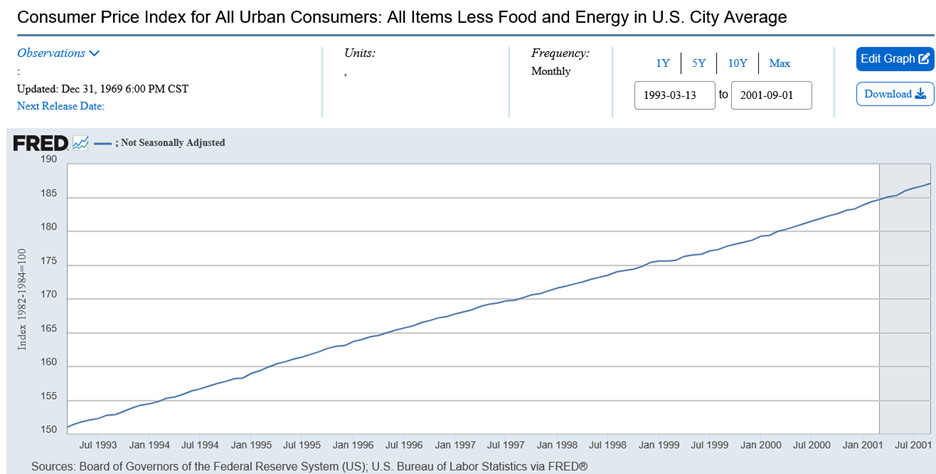
Here is core inflation in the first few years of free trade with Mexico and Canada. More cars and more food imported into the country duty free from a low cost nation – prices still rose.
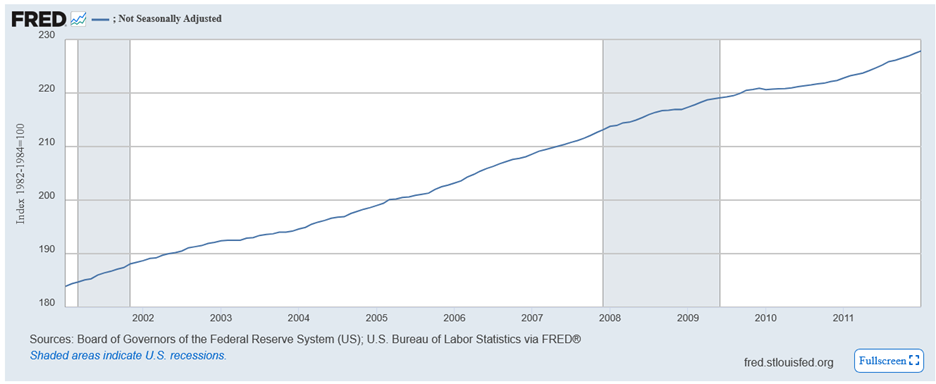
And here were are after a decade of China being granted Most Favored Nation status as member of the World Trade Organization. China at the time was making everything sold in a shopping mall.
And Covid…
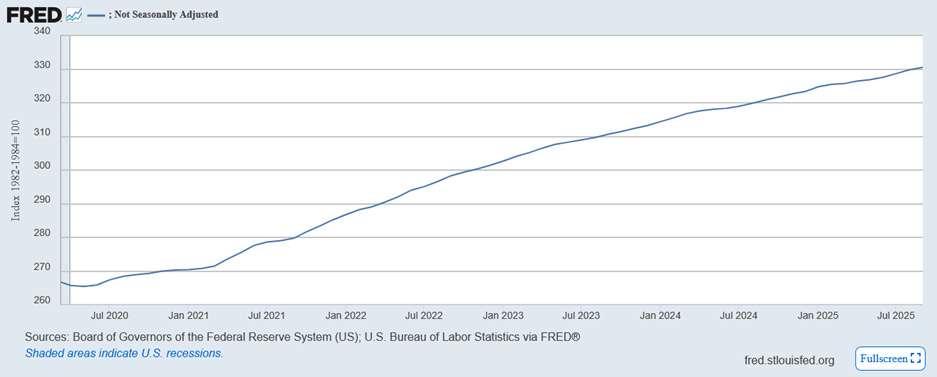
Prices keep rising despite record immigration, free trade deals that usher in lower cost (supposedly) imports, and China’s rise which was deflationary for many commodities, but not for things like housing, health insurance, school tuition, phone, cable and internet and electricity.
If you’re for open borders and for unqualified “free trade,” you don’t get to clutch pearls about the cost of living or rising rent. The two projects—mass, low-skill immigration and hyper-globalization—both expand the supply of labor and the supply of imports. That combination suppresses wage growth for the domestic working and middle class while undercutting the industries that would otherwise employ them at better wages. They folded. Or outsourced everything.
Start with trade. The consumer-benefit story is real—cheaper goods show up at Walmart. But the labor-market story is real, too, and for certain communities it dominates. MIT economist David Autor’s “China Shock” work documented that import competition from China raised local unemployment, reduced labor-force participation, and depressed wages—and that these effects were persistent, not brief “transitions.”
In their published paper, Autor, David Dorn, and Gordon Hanson put it plainly: “Alongside the heralded consumer benefits of expanded trade are substantial adjustment costs and distributional consequences,” with wages and participation “remaining depressed” for years in exposed regions.
Dani Rodrik, who’s hardly a protectionist caricature, warned more than a decade ago that hyper-globalization can erode the social compact unless nations retain room to manage distributional trade-offs.
In The Globalization Paradox he noted that globalization, on its own, does not build the capabilities—skills, technologies, public institutions—that lift wages; it mainly rewards countries that already have them.
“Globalization on its own does not generate these capabilities; it simply allows nations to leverage better those that they already possess.” In practice, that means countries (and communities) without such capabilities can get squeezed financially.
In a September 2024 op-ed, Rodrik framed a new trilemma: under current policies, you cannot simultaneously “boost the middle class in advanced economies and reduce global poverty” without trade-offs—one goal tends to come at the expense of the other. Add rising services costs due in part to government idealogues and incompetence, and demand from a growing population, millions here illegally, and you get the rising cost of living.
If Trump and his surrogates don’t want the (mostly useless, foreign facing Republicans) voted out of office and into a minority, maybe a deep minority, in the mid term elections next November, they have to do the following:
Remind people that the cost of living is worse in blue cities and blue states. Where else do you have unaffordable rent and and $5 gasoline other than in California and NYC, Democratic Party strongholds. Force them to show where years of Democratic Party policies led to lower living costs. Worse yet, these same places are teeming with illegals and fake CBP One asylum designations competing for jobs and housing.
The America First agenda is about protecting labor. That means wage growth, not wage suppression caused by unrelenting imported labor, and zero tariffs where companies large and small will invest overseas and return to imports. Wage growth makes life more affordable.
The Fed is too slow to act. Lowering borrowing rates for new home owners leads to refinancing which saves hundreds of dollars a month in interest payments.
Joseph Stiglitz, former World Bank chief economist, can mostly be counted on to be a Democratic Party narrative shaper, going after Trump policies like the America First trade agenda, knows that the big winners of globalization were the global top 1% and the new middle classes in emerging economies. The losers were “the middle and working classes in the advanced countries.” Those are the people now staring at high grocery bills and high rent, especially in the blue cities where the locals are forced to compete with imported labor by the same managerial class now worried about the cost of living.
An influx of workers places downward pressure on wages, while often increasing margins for employers. Harvard’s George Borjas states the textbook point plainly: immigration “redistributes income by lowering the wages of competing American workers and increasing the wages of complementary…workers as well as profits for business owners.”
His reappraisal of the Mariel boatlift—when tens of thousands of low-skill Cuban refugees arrived in Miami—found wages for local high-school dropouts fell sharply, on the order of 10–30%, when you examine the directly competing group.
The impacts of unchecked immigration are concentrated and real.
Put the two together—import penetration that hollows out tradable-goods employment and immigration that swells the supply of lower-skill labor—and you’ve engineered exactly the world we’re living in: a labor market where bargaining power is weak at the bottom and middle, and a price basket increasingly imported from jurisdictions with cost structures our workers can’t match. Not only did corporate labor arbitrage not lower our cost of living, Americans are now faced with higher costs and a generation or two of outsourcing that the Trump administration is trying to reverse. This is going to take years to unwind.
There’s also an uncomfortable historical irony. Ha-Joon Chang revived Friedrich List’s line about successful nations “kicking away the ladder” after climbing it with tariffs and industrial policy. Whether you embrace Chang’s full program or not, the observation bites: we told our manufacturing base to compete naked in a world where rivals do not. Then we acted shocked when domestic capacity fell and real wages stagnated. This is where are today in building this post-globalist West. It is going to be messy.
If you want rising real wages and a tolerable cost of living for workers who don’t write AI code or own capital, you cannot run a simultaneous experiment in unlimited labor supply and unfiltered import competition.
So the next time someone signals virtue for open borders and maximal free trade, then pivots to complain about rent, groceries, or a job that hasn’t seen a real raise in a decade, ask a simple question: Which side of your own trade-offs are you on? Because the economics is clear. We designed a system that favors imports – imported goods, imported labor. We got that. But we didn’t get falling prices to go along with it.
Moreover, typical DC foreign policy misadventures led to higher cost of living. The Ukraine war drove up oil prices. That war was supposed to end, but we are obsessed with keeping it going. Fed refused to cut rates because of rising oil. Republicans were happy to go along with it because they thought it would hurt President Biden. And now Trump inherited that devastating monetary policy, with only two rate cuts so far this year. Need more. Lower oil and gas prices are key to getting the Fed to lower rates. If you see a 30% jump in oil, you can be sure you get higher inflation and higher inflation means higher living costs.
“I think Trump has been terrible on the cost of living issue,” said Vladimir Signorelli, head of Bretton Woods Research. “If that issue begins resonating, Republicans lose the House for sure, lose the Senate, filibuster is gone and there is impeachment hearing after impeachment hearing. You’re not lowering the cost of living that way. It’s a repudiation of America First and MAGA is dead unless you get a Marjorie Taylor Greene presidency. We should have 100 basis points cut in one fell swoop, that’s the kind of thing you need to provide relief. I would do 200! Open borders and free trade are not a cure for cost of living. Trump has to address the issue.”